
AI used to be the party trick, now it is the event organizer, MC and chief attraction
As we move into the era where AI becomes embedded firmly into every conceivable area of products and commodities, design comes even more into the forefront.
This guide is intended for not just designers, but software engineers, product managers, and anyone who maybe or will be working on AI/ML based software. This will help you create AI based products that will delight people, and define paradigms.
1. Get your facts straight, then twist them at leisure
Start with basic requirements gathering. Even though the veracity of the information display is not strictly a function of design, it is still part of the interface and experience. And in cases where the experience hinges on the factual accuracy and precision, you better get them straight.
Then, think about edge cases and absolute worst cases, and then magnify that 10x (i.e., twist them at leisure). And you will start to have a roughly correct picture of what to handle.
“In AI based design, veracity becomes a priority.”
2. Don’t overdo it

“You don’t need to show the perfect emoji that will unite the world and solve world hunger.”
Less is better. Think about making the AI really shine in 3–4 key areas per screen. Don’t spread the AI goodness too thin.
3. Concentrate on insight, the spectacle takes care of itself 💡>🎆
Resist the urge to “wow” the user with some sort of nugget of discovery — it is unlikely to exist (think clippit and chatbots). Most people probably already know this and get annoyed by obvious things served up in the name of AI.
Instead, if your product only ever provides one really useful piece of information every 3 months, that would be a great success. A good rule of thumb is: You’re on the right path if the reaction you get is “Huh? I should think about that more” instead of “Oh great, here’s another thing to ignore”.
4. Differentiate human and machine actors 🤖😎
This harkens back to one of my other rules for design — information and context. Take a chat or email app as an example. One of the most important considerations is clearly labeling the source of different messages — i.e., who sent what and when.
AI based apps have similar considerations, but at a more subtle level.
a. Was a data point supplied by a machine learning algorithm, a virtual assistant, or some other program?
b. What is the type of data being shared with the user? Is it a helpful hint, numerical estimate, or a hybrid result?
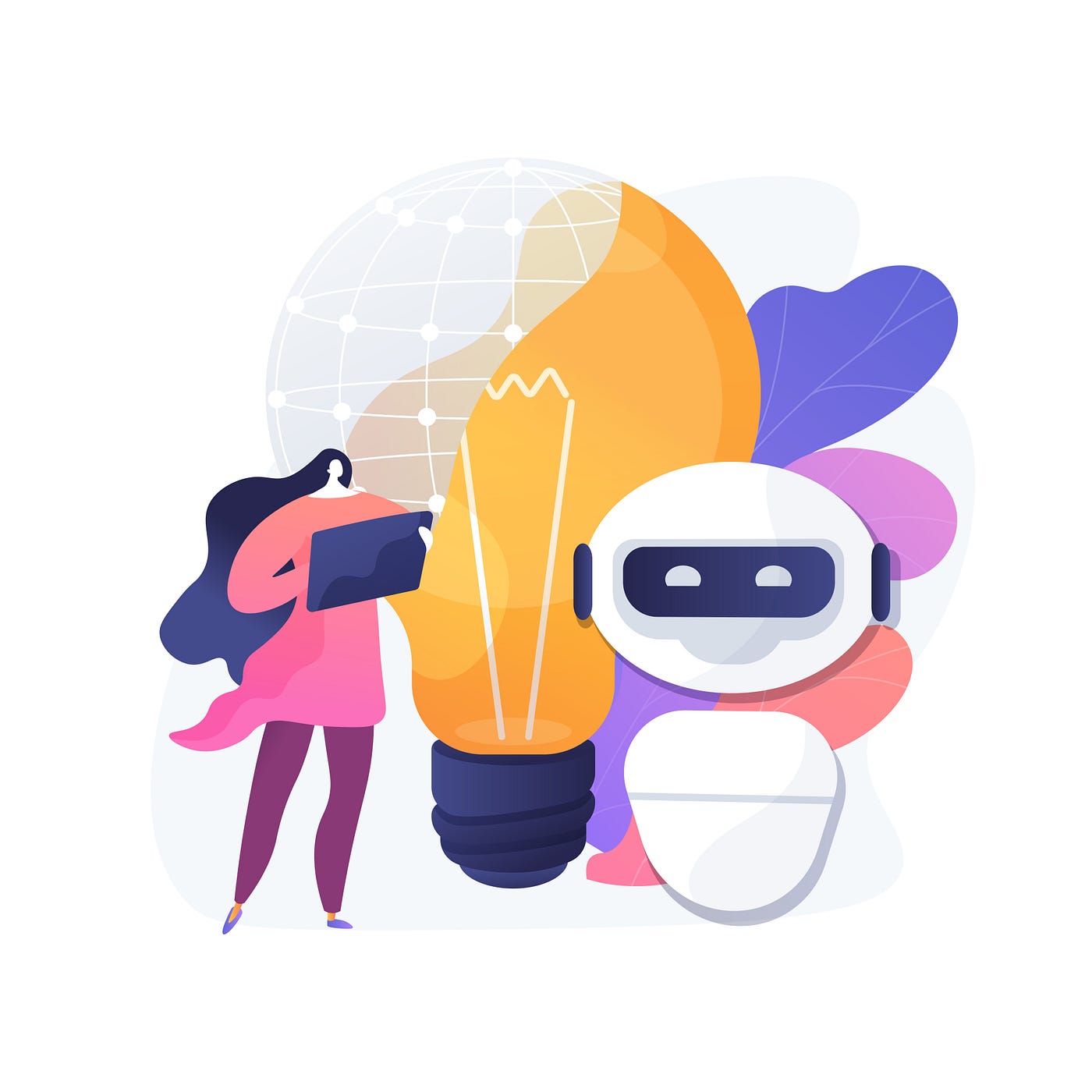
Clearly differentiating the sources different points of data come from is crucial. This can be done with icons, a different section, or simply indicating the source in plain english. The best thing would be to build these into the visual language you lay out for your designs.
5. Every outcome need not be visual📢📨📃🎛️
This rule applies to most aspects of user experience. But it is particularly pertinent for an AI-driven experience. Too often designers, product managers and other stakeholders push the visual spectacle above everything else; and this leads to unnecessary clutter. Instead of visual outcomes, consider the following:
a. Sound: If the exact numbers or values are not important, often it is enough to give a simplified understanding through well chosen sounds and auditory feedback.
b. Navigation: Get the user to the right place at the right time. Keep in mind that most software are state machines structured as trees. So, one of the best applications of AI/ML can be effectively and simply implementing the state transitions.
c. Physical Output: Controlling the ambience and environment — smart electronics for example — from a simple refrigerator or AC system to an entire building.
d. Peripherals/Connected Devices: Sending communication to connected devices like phones, tablets, smart home assistants.
e. Miscellaneous Outputs: Emails, printouts, reports, printable PDFs, images all qualify
6. Hindsight is fine, prediction is better 🔮
Providing a report of what has happened has some intrinsic value. But the greatest value AI/ML can provide is predicting outcomes. Think of how good this is for areas like healthcare, mission critical systems and scientific apps.
If the inherent promise of AI is having more control over the future, why not the same positioning for AI-driven experiences?

7. Inform, wow and delight; don’t spook 🛑😱
Pay attention to ethics.
Compared to traditional design challenges, AI and ML make it extremely easy to cross ethical boundaries (If you think you have ethics nailed down, remember that ethical considerations are always gray.)
Safeguarding privacy, personally identifiable information (PII), personal health information (PHI), should be utmost priorities. This is especially true when there are enough data to reliably predict or piece together compromising information.

8. Sometimes, humans are the best and only solution 🙋♀️
Looking at you, chatbots.
“Design is about delivering business value by affording the best possible experience. It is not about keeping users running the hamster wheel of frustration in the name of new technology.”
TLDR: If your application involves a chatbot or IVRS with not a lot of sophistication and even less common sense, then the best AI is no AI.
In Conclusion 👑
Follow CROWNE and you will probably create a damn good AI-driven experience.
- Common Sense: Let common sense be your guide
- Reality: Ground your designs in reality, without trying to reach for stars that may not exist.
- Obvious: Do not overlook the obvious.
- Worst Case: Multiply the worst case scenarios by 10x.
- Network: Think about the entire network of resources and devices at your disposal.
- Ethics: Always be ethical.


